SaaS · Toronto

Curbside Laundry

A pickup and delivery laundry platform, with an operations dashboard that runs the whole business.

Next.jsWeb appCRM dashboardPayments
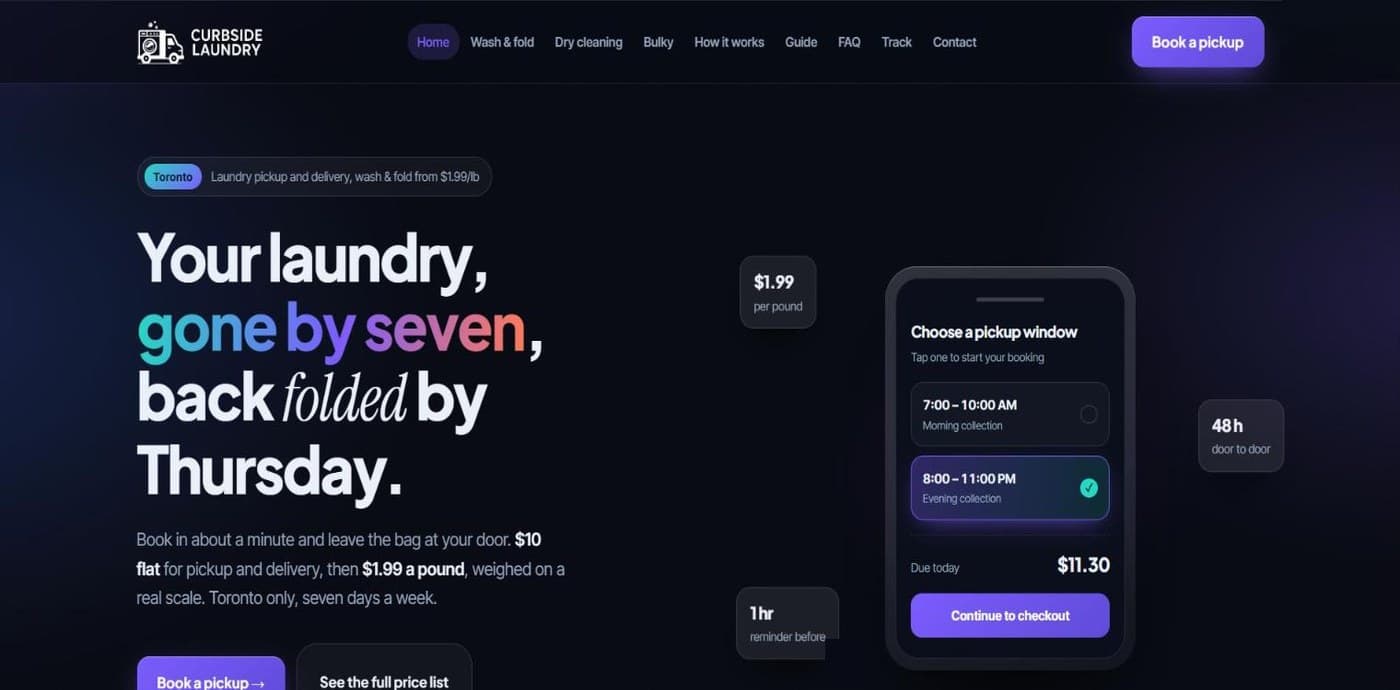
Curbside Laundry interface
What changed

The same job,
minus the manual part

Switch between how the work ran before, and how it runs now.

  • Orders arrived by phone and messages, at any hour
  • Driver routes were worked out by hand each morning
  • Payments were chased one customer at a time
  • Nobody could answer "how many orders are open" without counting
The build

How it was
put together

In the order it was built, and why each part exists.

  1. 01

    Booking that finishes

    A short multi-step flow: address, schedule, service, payment. Each step validates before the next, so a customer never reaches the end and discovers the slot was unavailable.

  2. 02

    The operations dashboard

    Total orders, pending orders, customers, revenue, active drivers and average processing time on one screen, with a live activity feed underneath.

  3. 03

    Driver and route management

    Scheduling, assignment and service-area rules, so dispatch stops being a manual decision made twice a day.

  4. 04

    The commercial layer

    Payments, promo codes, inventory and pickup queues, plus customer communications, all in the same interface rather than four separate tools.

The problem

Laundry pickup is a simple promise and a complicated operation. The customer wants a time slot and a price. The owner needs to know which orders are open, which driver is nearest, what has been paid for, and what is sitting in the building.

Before this build, all of that lived in messages, notebooks and the owner’s memory. The business could not grow without the owner being awake.

What we built

Two halves of one system. A customer-facing booking flow that takes a few minutes and is honest about price and turnaround, and a dashboard that gives the owner control of the entire operation.

The dashboard is the part that mattered. Orders, driver scheduling and assignments, service areas, payments, promo codes, inventory and pickup queues, with a recent-activity feed so the state of the business is legible at a glance.

Why it holds up

Booking and operations were designed together rather than bolted to each other. A change to service areas immediately changes what a customer can book, because both read the same source.

The owner can answer any question about the business from one screen. That is the difference between a website and a system.
24–48h

Stated turnaround, end to end

1

Dashboard replacing four tools

0

Orders taken by phone at 2am

Next

Want something
like this

The first call is a conversation about your process, not a pitch.

Next case studyDREDD AIAI · Blockchain risk