Custom platforms

When the spreadsheet
becomes the business

There is a point where the thing holding the company together is a file one person is afraid to touch. That is the moment to build something.

  • Custom web application development
  • Service business software
  • Custom CRM development
  • Spreadsheet to web app
How you know

Three sentences that mean it is time

If your business says any of these out loud, the spreadsheet has stopped being a tool and started being the system.

Only one person is allowed to touch that file.
The spreadsheet is now the system, and it has a single point of failure who also takes holidays.
We will just check with the office and call you back.
The answer exists, but not anywhere the person with the customer can reach it.
We cannot quote until we see it.
The price depends on something measured later, and no off the shelf checkout is built for that.
What a platform holds

The console behind one real business

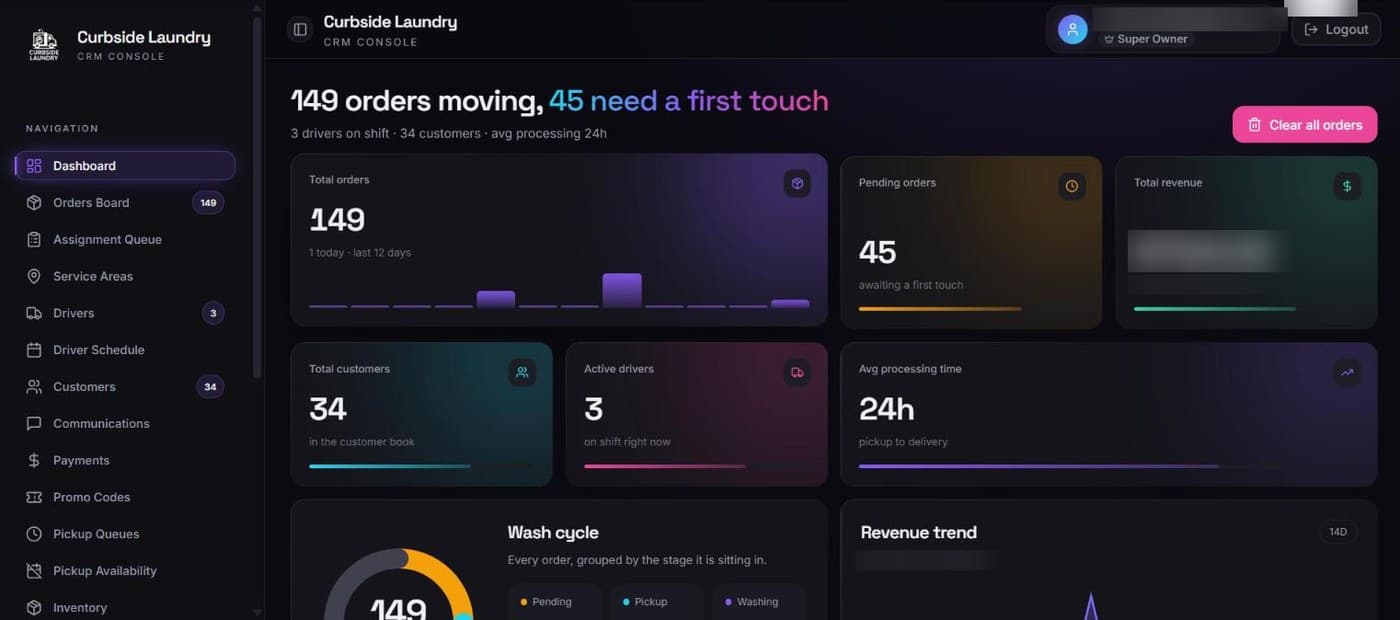
Not a feature list. This is the module map of the platform running Curbside Laundry today.

Work

  • Orders board
  • Assignment queue
  • Pickup queues
  • Availability
  • Reports

People

  • Customers
  • Drivers
  • Driver portal
  • Driver schedule
  • Users and roles
  • Communications

Money

  • Payments
  • Promo codes
  • Inventory
  • Templates

Places

  • Service areas
  • Routes

Every one of these carries role based access, so a driver sees the run and the owner sees the business.

The hard part

Charging before you know the price

Weigh, measure, inspect: plenty of businesses cannot know the total at booking. This is how that is handled.

01

Authorise at booking

The customer pays a deposit to hold the slot. The live site puts it plainly: pay just $10 plus HST to secure your slot.

02

Do the work, then measure

The load is collected and weighed. Only now does the real number exist, which is the part a subscription checkout cannot model.

03

Capture the balance

The remainder is taken against the same authorisation. Every transaction is tagged stage one or stage two, so the books can be read later.

Proof

Two platforms that are running right now

Curbside Laundry operations console: orders, drivers, payments and processing time on one screen
Operations platform, Toronto

Curbside Laundry

The problem

Orders arrived by phone and messages at any hour. Driver routes were worked out by hand each morning. Payments were chased one customer at a time, and nobody could answer how many orders were open without counting them.

What was built

A booking flow customers finish themselves, and the operations console behind it: the modules mapped above, all with role based access, plus two stage payments so a deposit is authorised at booking and the balance captured once the load is weighed.

What changed

After launch the owner stopped answering the phone to take bookings. The payments console shows 233 payments processed and no refunds, every transaction tagged stage one or stage two.

  • 20+Modules in the console
  • 233Payments processed
  • 0Refunds
  • 2Payment stages per order
Read the full case study
Subscription platform

A monitoring platform

Watches a source on a schedule, confirms a change is real before anything is sent, notifies the right person, and logs the whole sequence. A second process watches the monitor, because one that dies quietly is worse than none. It carries paying subscribers, with an admin for rules, recipients, subscriptions and activity logs.

Read the full case study
  • Runs without anyone watching it
  • Verify before notify, never the other way round
  • An admin an owner can actually operate
The part a product cannot bend around

The price is not known until it is weighed

A booking finished end to end on the live site. It stops at a Stage 1 payment, because the rest of the money only exists once the load has been on a scale.

A real booking on curbsidelaundry.ca, filled in with test details. The browser's own autofill panel is blurred where it appeared.
Before you commit

What an owner asks before building

Most of the time it is not, and you will be told that. Off the shelf products cover the common shape of a business well. Building is worth it when the thing that makes you money is the part no product models, like pricing a job only after it has been weighed.

The first working piece runs on your own data early, not at the end. You should be clicking through something before you commit to the rest, which is also the cheapest moment to change your mind.

It becomes the first import. The history in it is usually the most valuable thing you own, so it moves into the platform rather than being abandoned next to it.

The people doing the work get the smallest screen that does their job, and the owner gets the console. A driver should not be taught a CRM to collect an order.

You own the code and the accounts, opened in your name from the start. There is no licence and no per seat fee, and the handover is written down so another developer could pick it up.

Tell me how the work happens today

Not what you want built. How a job arrives, who touches it, and where it goes wrong. The first thing you get back is whether this needs building at all.