AI · Blockchain risk

DREDD AI

Paste a token address, get a readable verdict. On-chain data through risk heuristics, then a fine-tuned model.

Chat dashboardn8n backendFine-tuned LLMMulti-chain
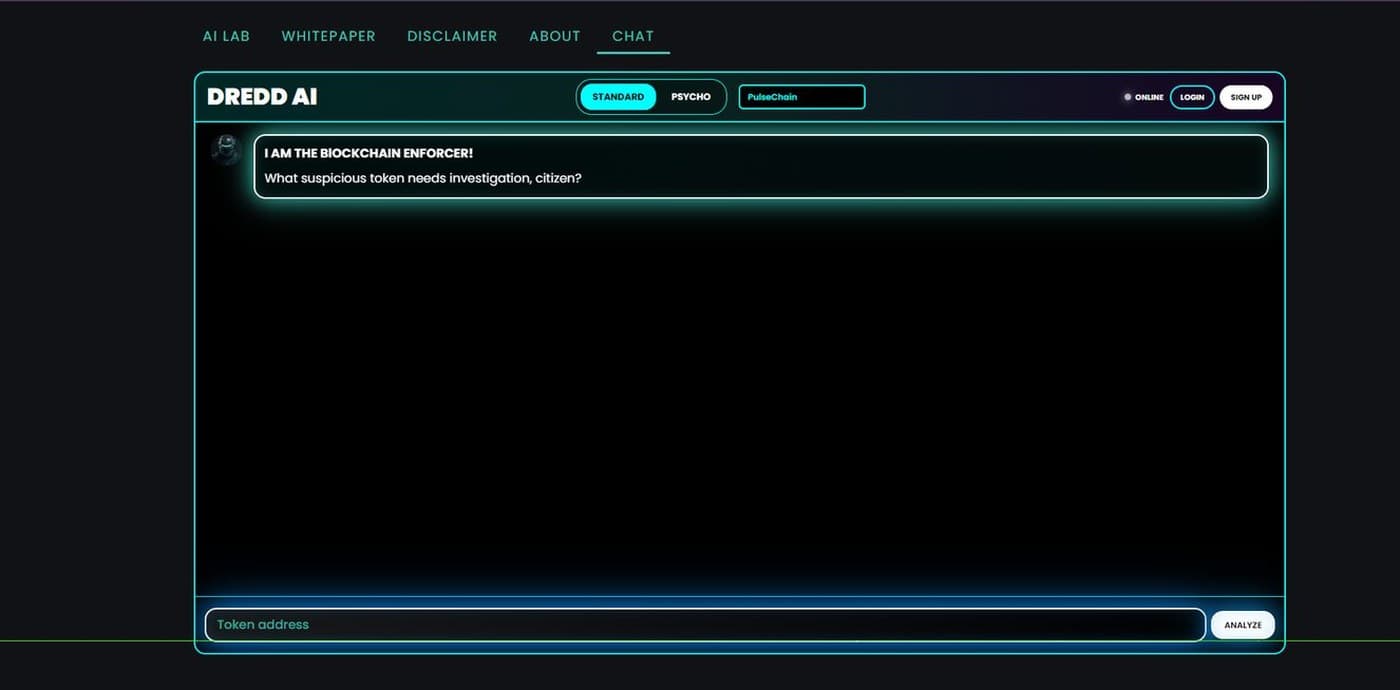
DREDD AI interface
What changed

The same job,
minus the manual part

Switch between how the work ran before, and how it runs now.

  • Checking a token meant opening four explorers at once
  • Holder concentration and liquidity read manually, chart by chart
  • The answer was a guess dressed up as research
The build

How it was
put together

In the order it was built, and why each part exists.

  1. 01

    The conversation, not a form

    A chat dashboard rather than a report generator: paste an address, get a verdict, ask a follow-up. Two response modes, Standard and Psycho, for people who want the analysis blunt.

  2. 02

    The workflow behind it

    A submitted token triggers an n8n workflow that pulls live on-chain data, rather than an application calling an API and hoping.

  3. 03

    Risk heuristics

    Holder concentration, liquidity, contract issues and suspicious transfer patterns, evaluated consistently for every token so two checks are comparable.

  4. 04

    The readable part

    The evaluation is fed to a fine-tuned model that turns it into a human answer inside the same conversation, instead of leaving the user to interpret raw numbers.

The problem

On-chain data is public and almost useless to a non-specialist. The information that tells you whether a token is dangerous is spread across explorers, and it takes experience to weigh it.

The gap was never access to data. It was interpretation.

What we built

A conversational dashboard with an automation backend. The interface is deliberately plain: an address goes in, an analysis comes back, and the conversation continues.

Behind it, an n8n workflow gathers live chain data, runs it against risk heuristics, and hands the result to a fine-tuned model for the write-up. Ethereum, BSC, Polygon, Solana and PulseChain are supported.

Why the architecture matters

Putting the analysis in a workflow rather than in application code means a heuristic can be changed, retried or rerun without redeploying the product.

It also means each stage is inspectable. When a verdict looks wrong, you can see which step produced it.
5

Chains supported

2

Response modes

1

Input: the token address

Next

Want something
like this

The first call is a conversation about your process, not a pitch.

Next case studySEO Command CenterPlatform · Internal