Technical SEO

Being findable is a
structure problem first

Most small business sites are not losing to better writing. They are losing because the pages people search for do not exist, or because something on the site is quietly telling Google to ignore them.

  • Ecommerce SEO services
  • Shopify SEO services
  • Local SEO for small business
  • Programmatic SEO
What is usually wrong

The symptom, the usual answer, and the cause

Three of these come up again and again, and in each case the common advice treats the symptom.

We rank for our own name and nothing elseWrite more blog postsThe pages for what people actually search do not exist yet
Google is not indexing usSubmit the sitemap againSomething is telling Google not to, and it is usually a canonical
Our products get no trafficRewrite the descriptionsEvery product page is the manufacturer text, so nothing is unique
A real audit

What one audit found in live Search Console data

  • The homepage was canonicalised to the wrong hostname
  • Zero of five submitted pages were indexed
  • Search Console was reporting the problem, and nobody was reading it

None of that is content work. A site can publish every week and stay invisible while a single canonical tag points at the wrong hostname, which is why the audit comes before the writing.

The project this audit was run on
At scale

Product SEO for hundreds of pages, with a gate

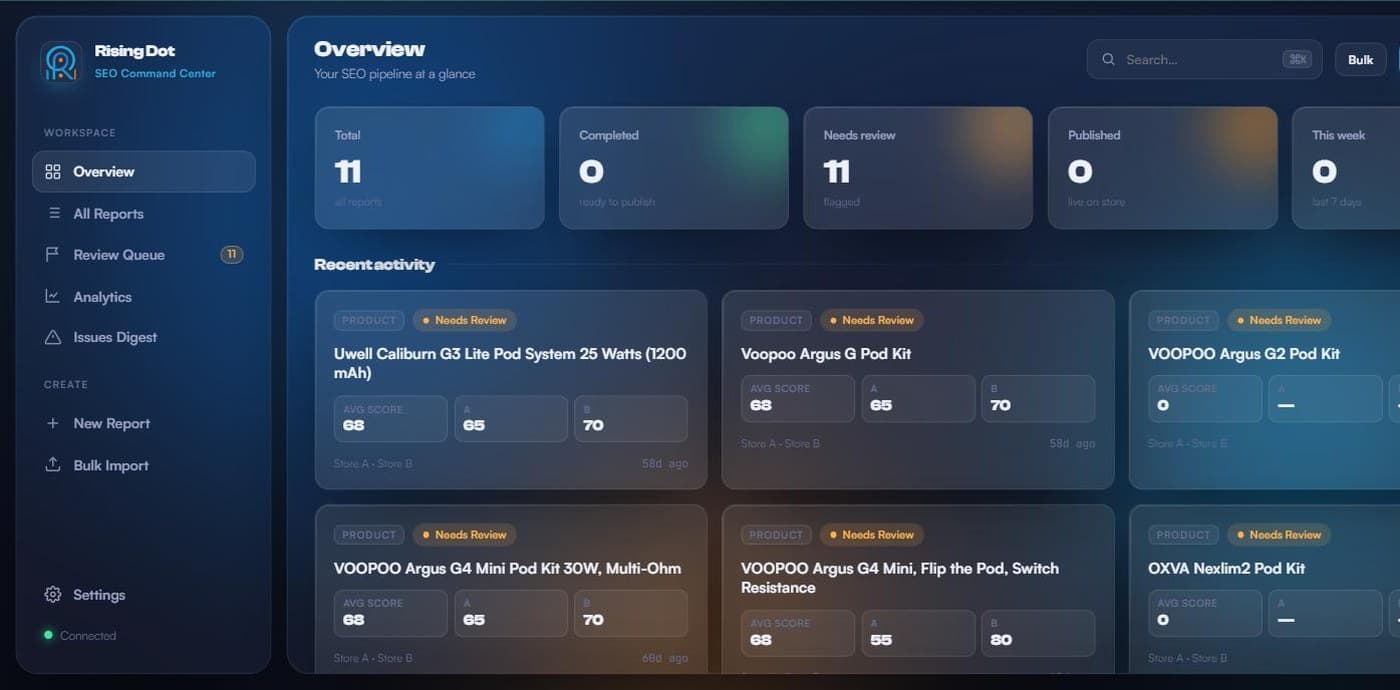
SEO Command Center overview: eleven reports, all flagged for review, with a per store score on each
Platform, two live stores

SEO Command Center

Products from two live stores run through a scoring and generation pipeline built to a fourteen module format, then land in a review queue. Nothing publishes until a person approves it, and anti duplication rules keep the two stores off each other terms. Thirty plus products were corrected by hand rather than trusted straight out of the pipeline, and eleven content pages were written, five of them location pages carrying LocalBusiness schema.

The store names are replaced with Store A and Store B in these screenshots. The clients are named elsewhere on this site; their pipeline internals are not.

Read the full case study
What the work covers

What is actually in the engagement

Technical audit
Indexing, crawlability and Search Console, read properly rather than screenshotted into a report.
Schema and JSON-LD
LocalBusiness for multi location, FAQPage where the page answers questions, product markup where it sells.
The pages that are missing
Location and service pages built to a repeatable structure, chosen from search data rather than from a sitemap someone drew.
Product SEO at scale
Generated to a fixed format, held apart by anti duplication rules, and queued for a human before it publishes.
Reporting that means something
Traffic and queries, not a vanity score out of a hundred from a tool you do not own.
Before you commit

The questions worth asking an SEO

Technical fixes can change indexing within weeks. New pages ranking is slower and depends on the term. Anyone promising a date is guessing, and anyone promising a position is selling something else.

Usually not. Most small sites need the pages that answer what people already search, built once and properly, before they need a publishing schedule.

Only behind a gate. The pipeline used here produces to a fixed format, enforces anti duplication rules, and queues everything for a person to approve before it goes live.

No, and neither can anyone else. What can be guaranteed is that the page exists, is indexable, is faster than what it replaced, and says what the business actually does.

Search Console access, or permission to set it up, and ten minutes describing what customers phone up to ask. Those questions are usually the missing pages.

Send the domain and one query you should rank for

The first pass is whether the page that answers it exists, and whether anything on the site is stopping it being indexed. That much you get back before any engagement starts.