For home services

Booked, dispatched, done
and paid, without a phone call

Quote before you know the final price. Assign the right person to the right address. Capture the balance when the work is finished. Every home service business runs this loop, and most of them run it on a whiteboard.

  • Job scheduling software for contractors
  • Dispatch software for small business
  • Home service business software
  • Service business software
The loop

Four stages, and the hard part of each

Every trade runs this. The difference between a product that fits and one that does not is usually in the third column.

01

Booked

The customer picks a slot that is genuinely available, not one that has to be confirmed by phone afterwards.

Availability has to know about the crew, not just the calendar

02

Dispatched

The job goes to the right person for that address, with the detail they need on the screen in the van.

Service areas are shapes, not a radius

03

Done

What was actually done gets recorded where it happened, including the parts that change the price.

The number is only known now, not at booking

04

Paid

The balance is taken against the authorisation from booking, without chasing anybody.

Two stage payment, or an invoice nobody pays for three weeks

Service areas, in the console

A radius is a circle. A route is not

Thirty two postal areas, each one on or off, and the booking form reads the same list. Turn one off here and it stops being bookable there.

The Curbside console. The account email in the header is blurred; nothing else on this screen is a person.
Same loop, different trade

What actually changes from trade to trade

The stages do not change. What changes is the thing that breaks the off the shelf version.

HVACSeasonal peaks, maintenance contracts that have to be scheduled ahead, and equipment history per address that the technician needs before arriving.
PlumbingEmergency work that jumps the queue, and quoting that cannot be finished until somebody has looked under the sink.
CleaningRecurring visits, the same crew requested by name, and keys or access codes that must never live in a group chat.
LandscapingRoutes that are geography before they are schedule, weather that moves the whole week, and jobs priced by the property rather than the hour.
Proof

The same loop, running for a real operation

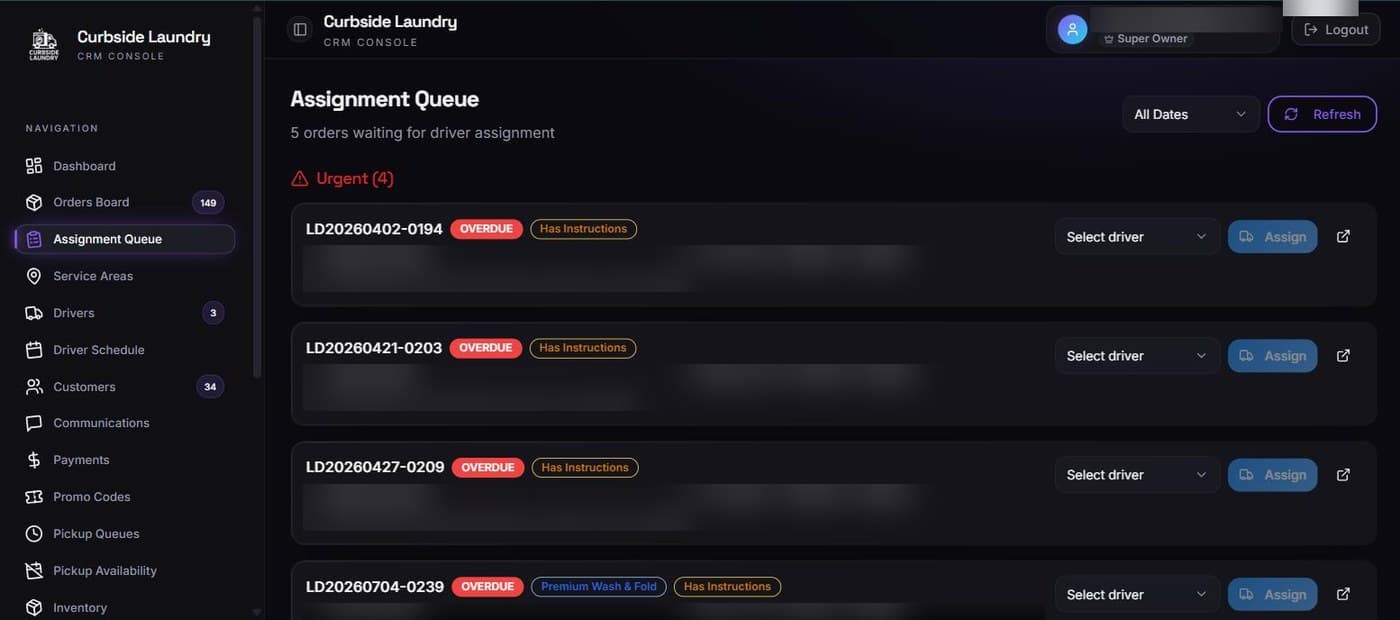
The assignment queue: jobs waiting for a driver, with the overdue ones called out
Pickup and delivery, North America

An operations platform

It happens to be a laundry, and that is the least interesting thing about it. The business took every booking by phone and worked out driver routes by hand each morning. It now runs on a 20+ module console: orders board, assignment queue, service areas, drivers and a driver portal, customers, communications, payments, promo codes, pickup queues, inventory and reports, with role based access so the person in the van sees the run and the owner sees the business.

Payment runs in two stages, a deposit authorised at booking and the balance captured once the load is weighed, because the price is not known until the work is done. 233 payments processed, no refunds. Swap weighing for measuring a lawn or inspecting a boiler and the shape is identical.

Read the full case study
Before you commit

What owners ask before building

Usually not at first. The common shape is a product doing most of the loop well and one stage of it badly, with a spreadsheet filling the gap. The cheapest fix is often building only that stage and connecting it, rather than replacing what works.

That is the part that decides whether any of this gets adopted. The field screen is built for a phone held in one hand, outdoors, and it shows the smallest amount of information that gets the job done.

Authorise at booking, capture the real amount when the work is finished. That is built and running on the project linked on this page, which exists because the price was not known at booking.

There is no per seat fee, because you own it. Adding people is an account, not a pricing conversation.

Walk me through one job, start to finish

How it arrives, who touches it, what decides the price, and where it goes wrong. That is enough to tell you whether to build or to buy.